Last March, RTHK (Radio Television Hong Kong) asked me for an interview on Mobile TV in Korea. RTHK producer Annie, who was in charge of ‘Media Watch’, visited South Korea to film the competitiveness of Korean Mobile TV which was commercialized in for the first in the Globe. (You can get more information on Korean Mobile TV market and its development from www.tdmb.org)
My interview was focused on providing them the newest trends and insights from Korean Mobile TV experiences. Once the Hong Kong TV people finished filming on Korean mobile TV industry for a whole one week, they told me that they really impressed about the advancement of Korean Mobile TV industry.
As RTHK were not able to have the prior knowledge on Korean mobile industry, My company, Veyond Partners also provided relevant support on arranging the adequate players of Mobile TV which are Samsung, TU Media, KBS, U1 Media, iStation, Ministry of Communication, Korean Broadcasting Commission.
I heard from Annie (who became a very close friend during her stay in Korea) that the Hong Kong audiences were really interested on Korea's Mobile TV and also some Hong Kong companies expressed interests on Korea’s mobile TV experiences once the program were televised in 10th March in Hong Kong. (You can find it from RTHK homepage www.rthk.org.hk/rthk/tv/cmedia_watch/20070310.html)
This is the sample clip that I appeared and I will try to upload some more later.
Wednesday, May 30, 2007
Hong Kong learns on Mobile TV from Korea


Monday, August 14, 2006
Will mobile music significantly increase operator mobile data ARPU? Case of MelOn in Korea

With the rise of ringtones and the proliferation of increasingly more sophisticated handsets, cell phones are moving ever closer to becoming true mobile music machines. And while the audio quality possible on handsets does not yet rival that of portable music players, the commercial success of ringtones shows that there is promise for driving music sales and the potential for for better applications as the technology allows it.
With these technical capabilities have come some business decisions. How will subscribers pay for this content – per song, on a subscription basis, or some other yet to be devised plan? What is the income model for the content creators such as the musicians and songwriters whose works will now be seen on portable devices? How will the carriers participate? How will the record companies get paid? How can mobile music file transfers be secured against the type of file-swapping endemic to the PC platform?
Making Mobile Music Work: SK Telecom-Music Goes Mobile

Here’s one excellent example of successful mobile music business model, SK Telecom’s ‘MelOn’. South Korea’s largest cellular company, SK Telecom, has provided a mobile music portal service called ‘MelOn’ since the end of 2004. MelOn is the first integrated, wired and wireless, music service that allows users to enjoy music virtually anytime, anywhere using a portable MP3 player, a PC, or a mobile phone.
The main MelOn interface is music download and streaming Internet portal, www.melon.co.kr. The service is akin to a rental service, with users “renting” tracks on a monthly basis for use on various terminals. MelOn users pay a 5000won(US$4.50) monthly subscription to stream music to a PC or wrappers on the music guarantee a subscriber is current, and tracks are erased from the end user’s library at the end of the subscription period. To download tracks onto the handset, users pay for airtime at regular call rates, regardless of the size of the track.
The key to the model is its ubiquitousness, downloads are possible using wireline and wireless platforms, and a relatively affordable monthly subscription fee. SK Telecom acquires the rights from the record companies for music to use as ringtones, ringbacks and full version downloads. Music companies are not necessarily enamored by the scheme, but SK Telecom has generally used its market heft to have its way. To further strengthen its position, SK Telecom acquired Korea’s YBM Seoul Records, reportedly Korea’s largest record company.
The MelOn service has received tremendous response from the marketplace, with the number of purchasers and paying subscribers virtually doubling each month. As of early June 2006, MelOn had recorded almost 4.5million subscribers; the number of paying subscribers that enjoy an unlimited amount of music for a monthly flat fee increased as well, reaching 0.6million. According to SK Telecom, the site ranked first among Korean paid music sites in terms of revenue.
MelOn - TV commercial #1
MelOn - TV commercial #2
MelOn - TV commercial #3
P.S.: I'll dicuss further detailed information about 'MelOn' on the 8th of September, 2006, at the W2forum-Consumer Trends & Technology Insights from Korea & Japan
Korea: U.S. adopts Samsung’s WiBro technology
Much talked about portable Internet service lands deal with three major U.S. companies
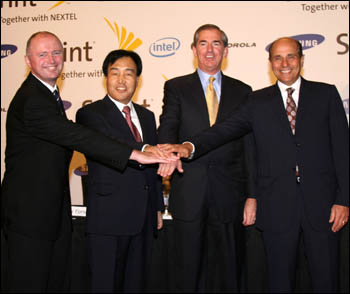
Samsung Electronics president Lee Ki-tae, second from left joins hans with Intel executive vice president Sean Maloney, left, Spring Nextel CEO Gary Forsee, third from left, and Motorola CEO Edward Zander at a press conference in New York, Tuesday, to announce their alliance for the launch of WiBro
South Korea’s homegrown portable Internet service, called WiBro here and known as mobile WiMax around the globe, is being deployed in the United States.
Samsung Electronics, one of the major Korean developers of WiBro, Wednesday forged an alliance with three firms; Sprint Nextel, Intel and Motorola for the launch of WiBro in the U.S.
WiBro lets people on the road remain hooked up to the Internet at the speed of a fixed line broadband connection. Its speed is fast enough to download dozens of MP3 files in a minute.
Sprint Nextel, the third largest U.S. cellular service provider, plans to invest as much as $3 billion to commercially roll out the Internet on the go service in 2008.
Sprint aims to have 100 million people covered by the go anywhere Internet application in 2008. A test service will be up and running by the fourth quarter of next year.
Together with Intel and Motorola, Samsung will provide Sprint with base station equipment, terminals and chipsets for WiBro, which debuted in Korea late June.
This is a milestone decision for Samsung and they’re sure Sprint will play a pivotal role in the worldwide initiative for telecom renovation on the desk of WiBro.
Sprint’s move will have an impact for beyond U.S. shores it will help WiBro tap into other nations down the road.
Experts concur that Sprint’s embrace of WiBro will bode well for its expansion.
It is meaningful that the locally developed WiBro is being adopted as a backbone network of the U.S., and other overseas telecom firms are expected to follow Sprint. In other words, WiBro will be able to enjoy a halo effect in its globalization efforts thanks to Sprint’s high profile.
Korea’s dynamic telecom duo KT and SK Telecom embarked on WiBro in late June and the next generation services presently cover some areas of Seoul and Pundang, Kyonggi Province.
KT, the country’s foremost landline operator, will expand the WiBro service range across the capital by the end of this year before going nationwide.
Samsung is developing a WiBro terminal, which can double as a cell phone, with the aim of completing the task early next year, to boost the vitality of the futuristic service.
Thursday, August 10, 2006
Is the sports contents saviour of Mobile TV? Case of TU Media in Korea.

TU media, a satellite DMB service provider is having fun with ‘Seung’s killer effect’.
In the United States, there's New York Yankees and in England, there's Manchester United and Japan, there's Yomiuri Giants where Korea's hero, Lee Seung Youp(29) is currently playing for. TU media goes on live cover every time when he plays a brilliant role. Thus, its rating and subscribers have increased in substantial amount.
On August, 1st , TU media’s live baseball coverage rating has gone up to 3.12% when Lee Seung Youp hit his four hundredth and ended the affair with pinch-hit two-run homer making it four hundredth and first career homeruns.
Lee Seung Youp’s live game coverage brings tremendous advertising effect which leads to actual data where rating has almost doubled up, 1.75 times greater than the average rating of July’s 1.78%.
People either in the bus or subway, viewing satellite DMB have increased in substantial amount, thus, subscriber base is naturally becoming wider.
TU media showed the great power of satellite DMB through out the citizens of Seoul. People in the Seoul subway viewed the game through satellite DMB, screaming out “Yeah!!!”, when Lee Seung Youp closed the game with two-run homer.
Games played in the midnight hour are rebroadcasted during the office-going hour.
According to TU media, if satellite DMB is exposed during the office-going hour when shower effect is the greatest, it has ten times stronger impact and influence than terrestiral-TV commercial.
Sports related contents are definetely killer contents and TU media has proven the fact by the result of its live coverage of sports games. TU media will go live starting the 19th with opening game of England Premiere League where Park Ji-Sung(Manchester United) is playing.
TU commercial
MLB into the world of TU : 34 channels only $13 a month
P.S.: I'll dicuss further detailed information about 'TU media' on the 8th of September, 2006, at the W2forum-Consumer Trends & Technology Insights from Korea & Japan
Tuesday, August 01, 2006
Gaming Addiction vs Gaming Professionalism
Case : South Korea
What effects that gaming culture has on the members of its society;
Gaming addiction vs gaming professionalism
How serious is gaming addiction?
According to the Washington Post, 2.4% of South’s Korea’s population aged 9-39 suffers from gaming addiction. Another 10.2% are considered to be borderline cases.
In 2005 alone, ten people died from game addiction related causes.
A couple in Incheon, Korea was arrested in June 2005 when they left their 4-month old daughter alone at home for five hours while going to play World of Warcraft at a PC Baang(Internet café). The baby died of suffocation from turning over on her stomach while the parents were gone.
A number of reasons are blamed for the rise of online gaming addiction in South Korea. They range from the longer amount of time needed to finish extensive gaming objectives or storylines, to inexpensive Internet access (averaging $30.00 a month for household high-speed Internet services), to a society used to living in small apartments or homes trying to escape unfulfilling daily lifestyles.
The Washington Post says, “Gaming addiction is in part because young people here suffer from acute stress as they face educational pressures said to far exceed those endured by their peers in other countries. It is not uncommon, for instance, for South Korean students to be forced by their parents into four to five hours of daily after-school tutoring. With drug abuse and teenage sex considered rare in the socially conservative country, escape through electronic games can be a huge attractive outlet.”
What is addiction?
Addiction is currently defined as a behavior over which an individual has impaired control with harmful consequences (Cottler, 1993; Rounsaville et al.,1993 in Robert West, 2001). Thus, individuals who recognize that the behavior is harming them or those whom they care about find themselves unable to stop engaging in the behavior when they try to do so (Heather, 1998 in Robert West, 2001). The severity of the medical, psychological and social harm that can be caused by addiction, together with the fact that it violates the individual's freedom of choice, means that it is appropriate to consider it to be a form of psychiatric disorder: a disorder of motivation (Robert West, 2001).
Addiction typically involves initial exposure to a stimulus followed by behaviors seeking to repeat the experience. After a number of repetitions of the behavior-stimulus sequence, the addiction becomes established.
The starting point for a view of addiction as excessive appetite is that there exists a range of objects and activities which are particularly risky for humans, who are liable to develop such strong attachment to them that they then find their ability to moderate their behavior significantly diminished.
Addiction, as an attachment to an appetitive activity, so strong that a person finds it difficult to moderate the activity, despite the fact that it is causing harm (Jim Orford, 2001).
What are the signs of gaming addiction?
- PC/Video game use characterized by intense feelings of pleasure and guilt.
- Obsessed and pre occupied about being on PC even when disconnected.
- Hours playing increasingly, seriously disrupting family, work, social life.
- Lying about PC Game use.
- Feelings of withdrawal, anger depression when not on or when uninvolved with game.
- Large phone or credit card bills due to online services.
- Fantasy life replaces emotional life with partner.
The South Korean government, in support of fighting game addiction, has taken several steps:
The Korean Agency for Digital Opportunity & Promotion operates centers where people can go to for help on gaming and internet addiction. In 2003, its forty centers counseled 2,243 people. In 2004, KADO counseled 8,978 people. Over 10,000 people were admitted to therapy programs in 2005. KADO’s programs consist of alternative recreational programs and group therapy.
South Korea’s Ministry of Information and Communication is also opening similar centers at universities and is funding anti-addiction courses at South Korea universities.
Not all intense gaming is a bad thing. A few intense gamers put their time in, and it becomes a successful venture for them: professional gaming. South Korea’s government is helping fund construction of the World’s first e-sports stadium, to be completed in 2008, where big screens will soon display big competitions.
Can gaming creat new revenue sources and have positive impact to its society?

The most successful professional gamers in South Korea are currently playing Starcraft, FIFA Series, and Warcraft Ш. Fewer than twenty players in the Korean Pro-Gamer Association make six figures a year, while about fifty out of its total 170 members make $40,000-$60,000.
Two cable TV networks, known as Ongamenet and MBCgame, compete for viewers with their own 24-hour programming dedicated to PC, console gaming and both cover South Korea’s professional gaming scene. Fierce gaming competitions are held, backed by major corporate sponsors such as SK Telecom’s T1, KTF’s Magicns, Pantech’s EX, CJ’s Entus, Samsung’s Khan and STX’s Soul providing interactive benefits for the team as well as for the enterprises’ name recognition. Game studios overflow with live audiences trying to catch a glimpse at players who are practically given celebrity status
Ongamenet, a 24-hour PC/console gaming cable channel. Their number one program is called Ongamenet Starleague, which is a three-month long Starcraft tournament broadcast live every Friday beginning at 7:00pm. Players in the final round compete for a top cash prize of $80,000. Second and third place winners can win up to $50,000 and $30,000, respectively.
Sky Proleague is a year long, with eleven Starcraft teams, eleven rounds, and a $100,000 dollar ultimate prize. Over 120,000 spectators attend the final match. It has four studio facilities, and is in the top twenty channels watched out of South Korea’s ninety-nine cable TV channels.
MBCGame covers Starcraft, Warcraft Ш, FIFA series games, CounterStrike, Winning 11, Age of Empire 3, and Dead or Alive.

Competition to win audiences among broadcasters already became fierce. It’s important to keep in mind that corporate sponsorship is involved as well, allocating millions of dollars in prizes and ad revenue.
Professionals and amateurs will gather at Seoul for the national qualifiers of the World Cyber Games (WCG) Aug.5-6. Organized by an affiliate company of Samsung Group, it has been the premiere international computer and video gaming festival since 2001. At the World Cyber Games (WCG), gold medal winning gamers bring in as much as $80,000 per tournament. The Olympic of video games was inaugurated in 2000 in Seoul, and now hosts players from sixty-seven nations. This year’s grand finals will be held at the F1 racing track of Monza, in northern Italy, in October, for the first time in Europe.
Sunday, July 23, 2006
Nexon mobile Releasing Three Games Aiming at Summer

 Nexonmobile is to concurrently roll out three games in genre of casual game, sports game, and role playing game aiming to dominate the market in summer. The company targets diverse age groups with 'Crazy Arcade B&B 2007', 'Crazy Baseball' a mobile games based on the popular online game'Crazy Arcade' and 'Epic Chronicle II' a large-scaled RPG game.

'Crazy Arcade B&B 2007', the leader of three games, is an action puzzle game based on the online game 'Crazy Arcade B&B' and, in which monsters, objects, item, and map themes with diverse characters not less than the online version appear. And it doubles excitement recreating 'Bula' an online version mission map as a quest for friends.
KARTRIDER into the Mobile Phone

'Crazy Baseball' a mobile baseball game is made to enjoy a game with a team that user forms with friendly characters like Baezzi, Marid, Digini. User can use items used in the online version of Crazy Arcade like Buster, Water-fly, and spaceship to a baseball game.
'Epic Chronicle II' representing a dramatic RPG game is said that the outstanding graphic and unique system of the game exceeded the limit of a mobile RPG.
Friday, July 21, 2006
LG Mobile Targets New Generation


LG Mobile has been relatively low in market share but recently due to their stylish and breakthrough design, 'Chocolate Phone', they have blockbuster in the making. LG Mobile finally hit the sweet spot in the faddish mobile phone market. The Chocolate garnered industry accolades such as the prestigious European 2006 Reddot Design and IF awards for its exellence in design and user-interface, and has been drawing a lot of orders from distributors. And the handset was ranked the best selling mobile phone by Carphone Warehouse, Europe's biggest mobile phone retail chain.
LG Mobile is promoting its name recognition to a much higher standard via '2006 LG Action Sport' tournament, combining handset and extreme sport. The largest world scale extreme sport tournament, 'LG Action Sport Championship' draws impressive attention and it cut the first tape in Netherlands. LG Mobile is in session of '2006 LG Action Sport European Tour' hosting the tournamet for two days(July 14~15th) in Dance Valley, on the outskirt of Amsterdam, Netherlnands. Thus, to enhance brand image which implies challenge and youth.
The LG Action Sports World Tour was created to tie this global phenonmenon together into one global circuit that spreads the gospel of action sports. Designed to showcase these incredible sports to new audiences, to build heroes, and to help launch new careers for tomorrow's brightest stars, the LG Action Sports World Tour is the only global multi-sport series bringing A-list talent to a cohesive set of contests on multiple continents.
All New Chocolate Phone-LG KV6000
 In the event, LG Mobile is using SMS via handset and drawing substantial interests from European youngsters through carrying out preview exhibits of 'Chocolate Phone' which is one of the hottest model around the world from exclusively made for 'Chocolate Phone' handset booth.
LG Mobile expects the Chocolate's popularity will help expand its reach in Europe for the new generation, where sales are less than half those in the U.S.A. This year LG Mobile seeks to sell 70 million handsets, with GSM phones making up more than half of the total. The company sold 55 million phones last year. It's vital for LG Mobile to boost its European, espeically new generation, if it is to achieve its target of edging past either Samsung or Motorola to become the world's No.3 by 2008 or 2009.
LG Action Sport - Amsterdam, Netherlands
The LG Action Sports program is typical of LG Mobile event: Work patiently and strategically and strive to be the mobile leader by putting out the best products with a long-term vision and focusing on new generation to be the next future consumer. You won't want to miss even a second of these amazing events. Keep your eyes out for the 2006 LG Action Sports World Tour. It just might be coming to your town next!
Thursday, July 20, 2006
Korea's e-sport has become an icon to success

Lee Yoon-yeol who is attached to one of the professional Starcraft online game teams, PANTECH EX, a front man of the team comes into the spotlight by German financial paper, Handelsblatt. Only 21 years old, the progamer is making more money than the usual exucutives. Lee's annual income is over $800,000 and the number of his fan club members are skyrocketing to 170,000 members. In Korea, it's already an old fairy tale, that progamers are loved by people as to famous sports star or singers.
Through PANTECH-EX's player, Lee Yoon-yeol, Handelsblatt has concentrated the spotlight on PANTECH's interrelated distinctive marketing and Korea's e-sport industry. Annually, PANTECH-EX is sponsored around $1,500,000 by wireless mobile handset manufacturer, PANTECH.
There are 3 professional channels, broadcasting only computer games and 11 other professional Starcraft online game teams mostly attached to large enterprises.
Korean government is encouraging domestic game developers to march with a game boom phenomenon.
This year, PANTECH's interrelated enterprise has opened up a market in supplying 3G handsets to German mobile communication operator, E-plus. Armed with state of the art technology and design, mega-pixel camera phone has released in France, drawing steady interests from Europeans.
Shinhan 2006 Season 1 OSL (Ongamenet Star League) OPENING
Wednesday, July 19, 2006
Samsung & SK Telecom Joint Collaboration Boost HELIO

Helio is a joint venture between SK Telecom, Korea's leading mobile communications company, and EarthLink, the nation's next generation Internet service provider. The company is capitalized with $440 million of partner investments. Helio Guarantees total happiness in services.
Starting October, SK Telecom will concentrate on global operation to enhance 3G network access. Samsung will supply premium class CDMA handsets to Helio. In addition to supply of handsets, as CDMA wireless mobile operator, Sprint's communication network standard meets compatible, Samsung is planning to provide three types of premium class handsets with built in enhanced service function to Helio.
Samsung has shown outstanding support as VK went bankrupt. Starting 4th quarter, Helio will reorganize its main line-up to Pantech and Samsung. Since, Samsung has much higher name recognition than VK and Pantech, they're expecting to have quite an impact in drawing substantial subscribers.
TV commercial specially targeted for Korean Americans
TV commercial specially targeted for Americans
Monday, July 17, 2006
Future is in South Korea
This is an intersting article on what South Korea can provide to the rest of the world written by Business 2.0.
The future is in South Korea
Smart investments in broadband there have paid off in the form of a hyperconnected society -- here's how we can start reaping the benefits.
By Chris Taylor, Business 2.0 Magazine senior editor
June 14, 2006
SAN FRANCISCO (Business 2.0 Magazine) - I, for one, welcome our South Korean overlords.
Ninety percent of the country has blazingly fast, 3-megabits-per-second broadband at home, and similarly high-speed wireless connections on the road. The telecom market is fiercely competitive, and broadband service costs the consumer less than $20 a month.
There are 20,000 PC baangs, or Internet cafes, where you can rent a superfast machine for $1 an hour. Online gaming has become a way of life, with nearly 3,000 South Korean videogame companies boasting combined revenues of up to $4 billion.
As a result, South Korea has become the world's best laboratory for broadband services - and a place to look to for answers on how the Internet business may evolve.
Smart bet on broadband
How did this come about? In 1995, the South Korean government made what must rank as one of the most shrewd and far-sighted investments in business history. It spent big on a nationwide high-capacity broadband network that any telecom operator could offer service on, and offered subsidies so that 45 million Koreans could buy cheap PC's. Cost: a mere $1.5 billion.
Fast-forward 11 years: Korea is now the most connected and Net-addicted country on Earth. There are a few American companies who have benefited from the South Korean broadband boom: Blizzard, for example, makes a popular online game called Starcraft which is so widely played in South Korea that two TV channels broadcast Starcraft matches between professional players.
But the most popular services are homegrown.
Cyworld, for example, is a social network owned by a subsidiary of SK Telecom, the country's largest wireless provider. To an American eye, the Cyworld service looks like a mixture of some of the hottest US properties: it's MySpace meets Flickr and Blogger and AIM and Second Life.
Users have avatars that visit and can link to each other's "minihompy" - a miniature homepage that's actually a 3-D room containing a users' blog, photos, and virtual items for sale. Cyworld's digital garage sales include music, ringtones, clothes for your avatar and furnishings for your own minihompy.
Cyworld has penetration rates that would make Rupert Murdoch, CEO of MySpace parent News Corp. (Research), green with envy: An astonishing 90 percent of South Koreans in their 20s use the service. Celebrities and politicians set up their own minihompies, and the way to get ahead in twentysomething Korean society is to found a popular Cyworld club, or chat room.
Printing money
Most importantly, Cyworld is a license to print money. The service itself is free (and available on cellphones as well as online), but to buy all the extras - like ringtones and virtual furnishings - will cost you "acorns," the service's virtual currency. Cyworld sells its users $300,000 in acorns every single day.
With such a proven revenue stream, Cyworld is expanding fast. It launched in China and Japan last year, and a US launch is slated for later this year.
Some might dismiss it as a Korean novelty, but all of Cyworld's elements, individually, have been successful on these shores. And teens and twentysomethings who use social networks tend not to have much brand loyalty to one service if another offers cooler features. SK Telecom's ace in the hole is its experience with running a social network on mobile devices.
"Every social network is going to have to have a mobile component over the next year," predicts Jill Aldort, an analyst at Yankee Group. "It gives more stickiness to the service. There's going to be a social networking fatigue factor - users need novelty. And Cyworld clearly has more functionality than MySpace."
Whether or not Cyworld succeeds in the U.S., South Korea is going to continue aggressively targeting American Internet users. Its government has set a target of $1 billion a year in online game exports by 2007.
NCSoft, the company that runs Korea's most popular multiplayer online role-playing game, Lineage, has found a string of successes in the U.S. by learning quickly what Americans love: its City of Heroes and City of Villains online games were both number one hits here.
Lost in translation?
To be sure, there is much about South Korean culture that doesn't translate well. The country's love of cuteness is a little too saccharine for American tastes.
And part of Cyworld's success can be chalked up to users' incessant message-swapping - not answering a missive from a friend with all due speed is considered a faux-pas in Korean society.
There is a chance that the rise of broadband and the rise of online gaming will not be so interlinked on this side of the Pacific (though the runaway success of World of Warcraft suggests otherwise). There's a chance that US social networkers may prefer a stripped-down service with no avatars, bells or whistles.
But don't forget that US wireless operators used to dismiss Japanese advances in mobile phones in much the same way. Do users really want to send text messages, watch video on their phones, or buy ringtones, they mused, or is that something peculiar to Japan? Well, as it turned out, they do, and companies that bet early on the notion that technology can cross cultural boundaries, like Sprint Nextel (Research) and Cingular, won out.
So think twice before ignoring what's going on in Seoul. That shrewd government investment a decade ago may just have created a broadband hothouse that can give us a glimpse of the Internet culture's future.
MySpace is Cyworld in Korea
Cyworld or simply CY (Similar to Blog but more close to the concept of Web 2.0) has been one of the most successful merger of SK Telecom (or SK Communications if to say accuratley) has ever made so far and it actually creates ‘substantial’ revenue.
CY has been a really interesting social phenomenon in Korea for last couple of years and made huge impact to both general customer and businesses. Creating attractive CY was one of the highest priorities for the FMCG companies and the word 'CY Marketing' were newly created which can be interpreted as 'marketing activities utilizing CY'. Even the politicians or celebrities use CY to communicate with their supporters and fans.
It is like having you home not in physical location but in online space Mini Homepage or widely known as Mini HomPy, where CY users are putting their efforts to decorate it more nicely than others.
'And here come the secret of making money using CY.
Koreans (In Fact every one in the world) wants to differentiate themselves with others. It is why luxury goods, good costumes, jewels and many more items are sold in high price. But in order to differentiate youself with others you need something, say money, intelligence, degree, class, which is not easy to get instantly. You have to invest such as time, effort, hard working in order to get this.
But CY allows you to have this at least in virtual space with relatively cheap price with shortened period of time. You can be attractive in virtual space and differentiate yourself with mere efforts. It is like having Starbucks or consumable luxury not in real life but in on line. CY will not work exactly same on other countires as it has been in Korea, and there are more than ‘the instinct of questing differentiation’ to explain ths success of CY such as the growing importance of social networking.'
But in business wise, how Cyworld made money? Cyworld saw the businss opportunity (each individual wanting to differentiate themselves in a easy way) and allowed them to achieve that instinct (using digital items to decorate their personal online territory). It is classic business strategy. Find the business opportunity, and using smart STP (especially 10s, 20s) to lure the customers.
This is quite simple version of the success of Cy which is purely my personal view. I am happy to receive more open discussions/questions/ideas.
You can read more detail on CY from recent Business Week article www.businessweek.com/magazine/content/05_39/b...
Subscribe to:
Posts (Atom)
